
While Black History Month is an opportunity to recognize and celebrate the many past achievements of Black people, ViMLoC would like to spend each week highlighting some of the current Black library professionals in our network.
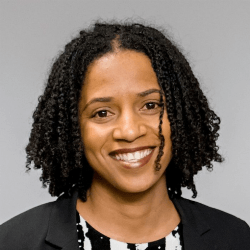
This week, meet Mandissa Arlain, a Library Technician at Ryerson University. She graduated with her Master of Information from the University of Toronto and is open to taking on a librarian position. If Mandissa seems like she would be a excellent candidate for your library, reach out to her to discuss the opportunity.
Tell us about someone who inspires you, and why?
The simple answer is everyone and everything. On my best days, life inspires me. All I have to do is open myself to the wonder that is life. Every sense allows opportunities for inspiration. In the grand scheme of things, when I compare my small existence to existence at large, there is way too much inspiration within and without, to not be inspired.
…however, in the context of Black lives and anti-Black racism during the month of February, and in relation to my experiences in the field of librarianship, I’ll share this:
Inspiration (not to diminish from ideals that lend well to this concept such as goals, striving and hard work), requires a backstory. That backstory usually relies on privileges such as respect, recognition, access to opportunity, encouragement, and allowances for mistakes and second chances. The coming together of those privileges and allowances into a cohesive end result is the fodder needed for the inspirational story. As a Black woman, I’m a member of that historically disenfranchised group who gets limited access to those closely gated privileges and allowances, and as a result, limited access to those outcomes. Not all Black women, but most Black women (I feel the need to add this disclaimer). For proof, all one has to do is compare the number of inspirational stories of Black female accomplishment and success to the deluge of other stories of inspiration out there, ours are fewer and farer between in comparison.
Now for me, or any of us for that matter, to be inspired by folks we’ve never met requires that we hear of them through some external means, in many cases through mediums put in place for the very purpose of us accessing those stories and experiencing the related inspiration.
I have seen how stories of recognition and inspiration work, and before inspiration is achieved, there is an entire machinery of support behind it. Remember Claudette Colvin? You probably wouldn’t, as her story didn’t make it into many of the inspirational accounts of the civil rights movement. Colvin’s story took place prior to the story of Rosa Parks, and it could be argued, was part of the inspiration behind Rosa’s refusal to give up her seat months later. The backstory includes strategy and organizing and even discriminatory practices by the very folks fighting for justice. Both supported the Civil Rights Movement, both refused to give up their seats, and both were arrested, however, the account goes that “Colvin did not receive the same attention as Parks for a number of reasons: she did not have ‘good hair’, she was not fair skinned, she was a teenager and she got pregnant. As a result, the leaders in the Civil Rights Movement tried to keep up appearances and make the ‘most appealing’ protesters the most seen.” Yeah, there’s some irony there, but such is the complexity of the inspirational story, and the sacrificed details required to “bend the arc of the moral universe toward justice.”
So who inspires me? Right now, it is those who have touched my life in very literal ways, and those who bring a smile to my face, a feeling of gratitude to my heart, or a nod of acceptance to my soul when I think of them. Those who have left me with good emotions and therefore good memories, or who have left me with lessons I can draw from as I move through this life. It is those, who by example, ignite the push that I sometimes need to get up and get going. Those are my inspirations.
Tell us one thing about yourself that others in the profession (or colleagues) may not know about you
I’m currently working with Dr. Anne-Marie Singh on a Criminal Justice First Project that looks to document the historical under-representation of Indigenous and racialized groups as criminal justice professionals in Canada. I also contribute to the 100 ABC (Accomplished Black Canadian) Women’s Book Project, that highlights the accomplishments of Black Canadian women. It’s a point of pride for me to support such initiatives.
Why did you choose to go into librarianship?
I grew up in libraries. My mom worked in one. My first job was as a Page at the Toronto Public Library. From there I completed the library technician’s diploma at Seneca College, and to be honest, it seemed like the next practical step. I enjoy the work of libraries, and support the ethos of access to information and opportunity for all, better yet when it’s free as with public libraries.
What are your thoughts on current EDI work in Canadian librarianship or academia?
I currently sit on OLA’s CDI committee and CARL’s EDI Working group, and it’s clear that Canadian librarianship has a long way to go to achieve EDI principles, particularly as it relates to opportunities for racialized professionals.
What are some of the resources that you would recommend to others about the profession?
Here’s one title: Aboriginal and Visible Minority Librarians; Oral Histories from Canada, edited by Deborah Lee and Mahalakshmi Kumaran.

 ViMLoC: Visible Minority Librarians of Canada